Category: Game History

Features on the PC games and studios that defined the late nineties and early two-thousands.

  • Patch culture before automatic updates

    A game bought on disc in 1999 was the version on the disc, permanently, unless the player did something about it. There was no update check, no background download and no notification. Patches existed, and finding out about them was the player’s problem.

    How people actually found out

    Discovery ran through the enthusiast press, cover discs, and word of mouth on forums and newsgroups. A magazine might mention that a patch had been released; the disc on the cover might carry it. Otherwise, a player had to think to check the publisher’s website, which required knowing it existed and having a connection worth using.

    Substantial numbers of people therefore played the shipped version indefinitely, bugs and all, unaware that fixes existed. This was normal rather than exceptional, and it shaped how developers thought about launch quality: the disc version was, for a large share of the audience, the only version.

    Applying a patch was a manual operation with real risk

    A patch was an executable that modified an installation in place. It usually checked the version it was upgrading from and refused if that did not match, because patches were often incremental: 1.0 to 1.1, then 1.1 to 1.2, with no direct route from 1.0 to 1.2.

    Miss a step and the sequence broke. Apply patches in the wrong order and the installation could end up in a state no patch recognised, with reinstallation the only fix. Anyone who modified game files, which included most people running mods, could find a patch refusing to run because a checked file no longer matched what it expected.

    • Patches were frequently one-way. Reverting meant reinstalling from disc and starting the chain again.
    • Saved games often did not survive a version change, and this was not always documented prominently.
    • Mods were version-specific, so patching could break a working setup with no route back short of reinstalling.

    Why version numbers still matter today

    Anyone installing one of these games now inherits the whole situation. The disc is at its original version. The patches that once lived on a publisher’s server may or may not still be findable. And any modification being used will specify a version requirement written when that version was current.

    This produces a recurring and confusing failure: a mod that will not load, with an error suggesting file corruption, when the actual problem is a version mismatch that the mod’s documentation stated plainly two decades ago.

    Digital rereleases complicate it further. A rereleased version is usually the final patch level, sometimes with additional changes for modern compatibility. That is convenient for playing and awkward for mods, because it may not correspond exactly to any version a mod was ever tested against.

    The practical approach

    Establish what version an installation is at before doing anything else. Most games report it on a menu screen or in a file header, and knowing it converts a vague problem into a specific one.

    Then read the mod’s documentation and believe it. Where it names a version, that is not a suggestion. Where a patch is required and no longer available from its original source, community archives frequently hold it, and this is one of the more valuable things such archives do.

    What was lost when updates became automatic

    Automatic updating is better in nearly every respect. Fixes reach everyone, the version is knowable, and nobody has to maintain a mental map of patch chains.

    What it removed is the ability to stay put. A player who preferred an earlier version, or needed one for a mod, could simply not install the patch. That option has largely gone, and with it the ability to preserve a specific version of a game as it existed at a specific moment.

    For a game as a product this rarely matters. For a game as an artefact, being unable to hold a version still is a genuine loss, and one that will become more visible as more of the current era’s software becomes historical.

  • Shareware episodes and the economics of giving away a third of a game

    Shareware episodes and the economics of giving away a third of a game

    For a stretch of the early and mid 1990s, a substantial share of PC gaming reached players as shareware: a complete, playable portion of a game, distributed freely, with the rest available by post or phone order. It is easy to mistake this for an early demo strategy. It was something rather different.

    The problem it solved was distribution, not marketing

    Getting a game onto retail shelves required a publisher, a manufacturing run, and a distributor willing to allocate space. For a small team this was frequently the binding constraint. The game could be finished and still not reach anyone.

    Shareware sidestepped it. The first portion of the game was copied by anyone who felt like copying it, onto bulletin boards, cover discs and floppies passed between friends. Distribution cost the developer nothing and scaled by itself.

    The critical design decision was making that first portion genuinely complete rather than a truncated sample. A shareware episode had a beginning, a difficulty curve and an ending. Someone who never paid still played a finished thing, which meant they were willing to pass it on, which was the whole mechanism.

    Why episodes specifically

    The episodic structure was not incidental. It solved several problems at once.

    • It gave the free portion a natural boundary, so distributing it whole felt complete rather than cut off.
    • It gave the paid portion obvious concrete value: two more episodes rather than a vague notion of more content.
    • It let a small team ship the first part and keep working, funded by whatever the first part brought in.

    That third point mattered enormously for teams without external funding. Revenue arrived while development continued, rather than at the end of a long unfunded stretch.

    The order mechanics were the awkward part

    Paying was deliberately made as easy as the era allowed and was still slow. An order form printed inside the game, a telephone number, a postal address. Money moved, then discs moved back, over days or weeks.

    This friction shaped the games. The registered version had to be worth waiting for, and the free episode had to leave the player wanting it enough to fill in a form and post a cheque. That is a much higher bar than a click, and it pushed developers toward making the free portion genuinely good rather than deliberately frustrating.

    The comparison with later free-to-play design is instructive. Shareware could not annoy people into paying, because annoyance simply ended the relationship with no further contact. It could only persuade them by being good.

    What ended it

    Broadband and digital storefronts removed the distribution problem shareware existed to solve. Once anyone could publish a game where anyone could buy it in one step, the elaborate structure of free episodes and postal ordering was solving nothing.

    Retail expectations also shifted. As production values rose, so did the cost of making a free episode that felt complete. Giving away a third of a game is a very different proposition when a third of a game costs a great deal to build.

    The residue

    What survived is the idea that a free portion should be self-contained and good, rather than a sampler that stops mid-thought. Where that principle is followed today it works for the same reason it worked then, which is that people are more willing to recommend something they enjoyed to the end.

    There is also a preservation consequence worth noting. Shareware episodes were copied so widely that they survive in quantity, while the registered versions, distributed in small numbers by post, are considerably scarcer. For some titles the free part is easy to find and the paid part is the rarity, which is an outcome nobody planned.

  • Why so many late-90s PC games shipped with a separate installer disc

    Why so many late-90s PC games shipped with a separate installer disc

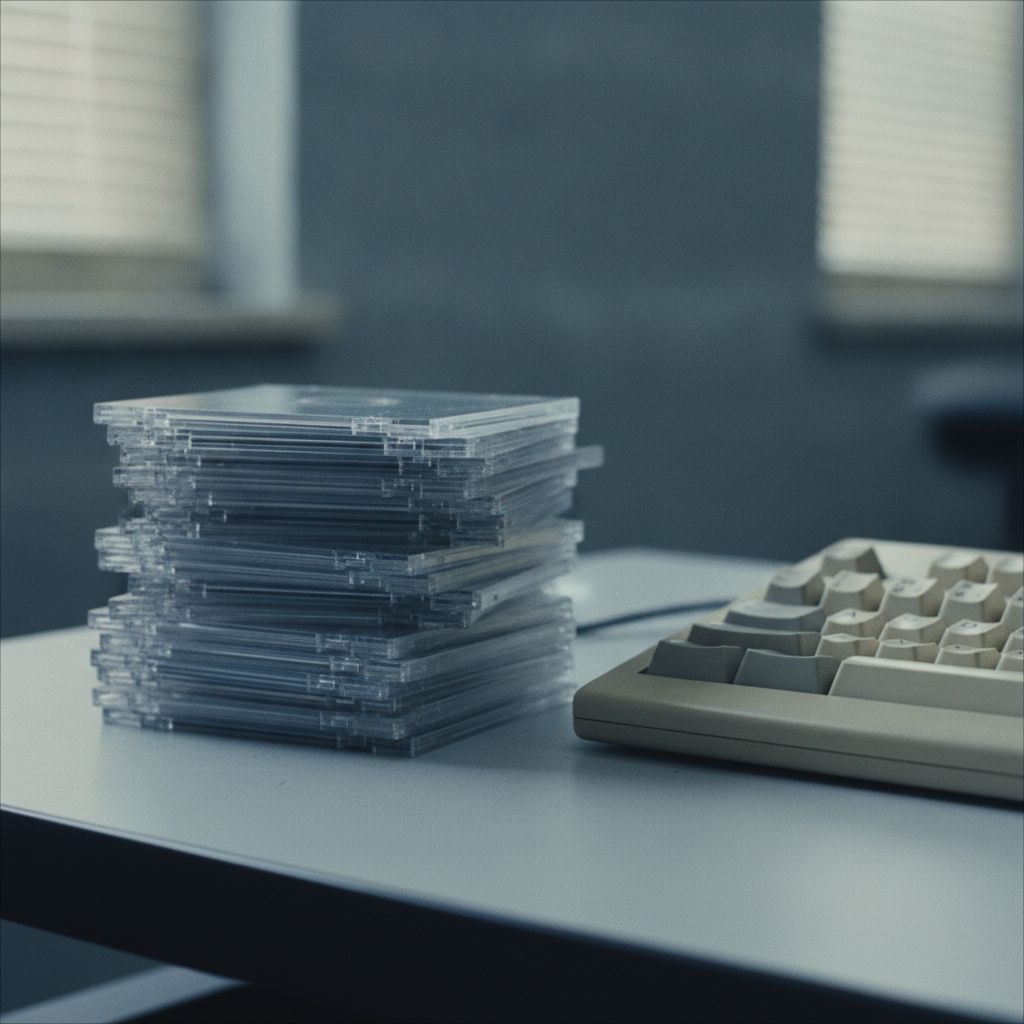
    Pull a boxed PC game off the shelf from around 1998 and there is a decent chance it holds more than one disc. The instinctive explanation is that the game was simply too big for one CD. Sometimes that was true. More often it was not, and the real reasons are more interesting than raw capacity.

    A CD-ROM held about 650 megabytes. A hard drive of the same period might offer two to six gigabytes in total, shared with the operating system and everything else the machine did. That mismatch, rather than the size of the game itself, shaped how releases were put together.

    Reading from disc was slow, and installing everything was not an option

    A 4x drive managed roughly 600 kilobytes per second on a good day, with seek times measured in hundreds of milliseconds. Streaming full-motion video or a large audio track off that disc during play was possible but fragile. Any stutter was immediately audible.

    Publishers responded by splitting content by access pattern rather than by size. Assets needed constantly went on the hard drive during installation. Assets needed occasionally, particularly cutscenes and music, stayed on the disc and streamed. A second disc was frequently just the video and audio that nobody wanted to spend 400 megabytes of precious drive space on.

    This is why installation size options mattered so much. Minimum, typical and full installs were not marketing choices. They were the difference between a game that ran and a game that would not fit.

    Copy protection wanted a disc in the drive

    Through this period the standard anti-piracy measure was a disc check. The game confirmed that a particular disc was present, sometimes by reading a deliberately malformed sector that ordinary duplication software would not reproduce faithfully.

    If the check demanded a disc anyway, there was no benefit to compressing everything onto one. A design that kept audio and video on disc two, then asked for disc two during the cutscene, achieved both goals at once. The player would have needed to swap discs regardless.

    Duplication economics rewarded more discs, not fewer

    Pressing CDs at volume was cheap, and got cheaper with quantity. The marginal cost of a second disc in an already-manufactured box was small compared with the engineering cost of squeezing content into one. Faced with a choice between weeks of asset compression work and adding a disc that cost pennies, publishers added the disc.

    There was also a presentation argument. A box with three discs looked substantial on a shelf next to a box with one. Whether that shifted units is hard to establish now, but the belief that it did was widespread enough to be repeated in interviews from the period.

    The awkward legacy for anyone installing these games today

    Two habits from that era create most of the problems now. The first is the hard-coded drive letter. Installers that recorded the CD drive as D: still expect D:, and a modern machine with a virtual drive mounted elsewhere will fail a check that has nothing to do with the disc itself.

    The second is the split install itself. Copy the contents of every disc into one folder and many of these games run perfectly, because the code looks for files by relative path and no longer cares which physical disc they came from. Where that fails, it usually fails on the protection check rather than on the assets.

    • Check whether the game reads a configuration file recording the install path and drive letter. Editing it is often quicker than reinstalling.
    • Copy all discs into a single directory before troubleshooting anything else. It resolves a surprising share of missing-file errors.
    • Expect audio to be the awkward part. Redbook audio tracks are not files on the disc and do not survive a naive copy.

    That last point catches people out repeatedly. A game using Redbook audio played music by asking the drive to play an audio track directly, the same way a CD player would. Copying the data track gets the game; it does not get the soundtrack. Extracting those tracks to a supported format and pointing the game at them is a separate job, and one worth knowing about before concluding that a copy is broken.

    What the multi-disc era actually tells us

    The shape of these releases was set by constraints that vanished within a few years. Drives got faster, hard drives got enormous, and broadband made physical distribution optional. What remains is a body of software with assumptions baked in about where things live and how fast they can be read.

    Understanding those assumptions is most of the work in getting one of these games running today. The problem is rarely that the game is old. It is that the game is confidently expecting a world that no longer exists.