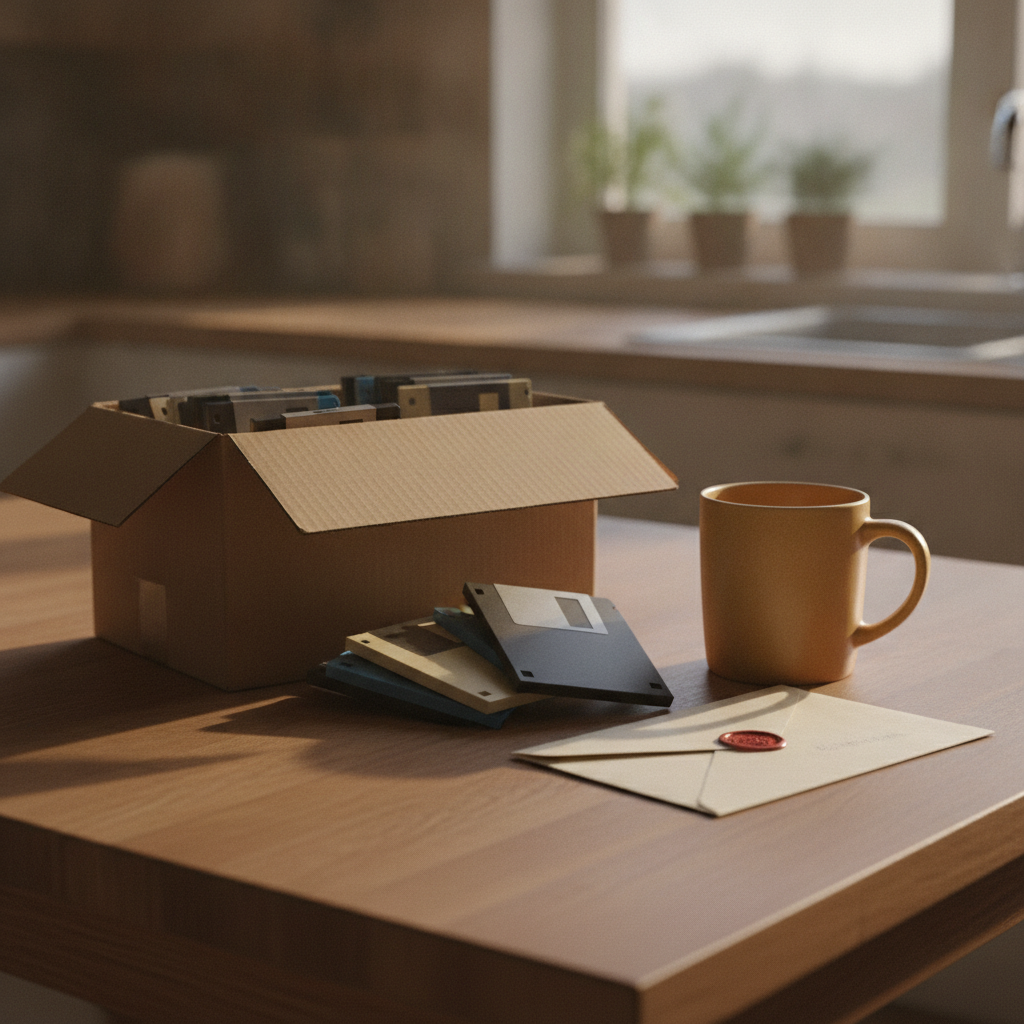
For a stretch of the early and mid 1990s, a substantial share of PC gaming reached players as shareware: a complete, playable portion of a game, distributed freely, with the rest available by post or phone order. It is easy to mistake this for an early demo strategy. It was something rather different.
The problem it solved was distribution, not marketing
Getting a game onto retail shelves required a publisher, a manufacturing run, and a distributor willing to allocate space. For a small team this was frequently the binding constraint. The game could be finished and still not reach anyone.
Shareware sidestepped it. The first portion of the game was copied by anyone who felt like copying it, onto bulletin boards, cover discs and floppies passed between friends. Distribution cost the developer nothing and scaled by itself.
The critical design decision was making that first portion genuinely complete rather than a truncated sample. A shareware episode had a beginning, a difficulty curve and an ending. Someone who never paid still played a finished thing, which meant they were willing to pass it on, which was the whole mechanism.
Why episodes specifically
The episodic structure was not incidental. It solved several problems at once.
- It gave the free portion a natural boundary, so distributing it whole felt complete rather than cut off.
- It gave the paid portion obvious concrete value: two more episodes rather than a vague notion of more content.
- It let a small team ship the first part and keep working, funded by whatever the first part brought in.
That third point mattered enormously for teams without external funding. Revenue arrived while development continued, rather than at the end of a long unfunded stretch.
The order mechanics were the awkward part
Paying was deliberately made as easy as the era allowed and was still slow. An order form printed inside the game, a telephone number, a postal address. Money moved, then discs moved back, over days or weeks.
This friction shaped the games. The registered version had to be worth waiting for, and the free episode had to leave the player wanting it enough to fill in a form and post a cheque. That is a much higher bar than a click, and it pushed developers toward making the free portion genuinely good rather than deliberately frustrating.
The comparison with later free-to-play design is instructive. Shareware could not annoy people into paying, because annoyance simply ended the relationship with no further contact. It could only persuade them by being good.
What ended it
Broadband and digital storefronts removed the distribution problem shareware existed to solve. Once anyone could publish a game where anyone could buy it in one step, the elaborate structure of free episodes and postal ordering was solving nothing.
Retail expectations also shifted. As production values rose, so did the cost of making a free episode that felt complete. Giving away a third of a game is a very different proposition when a third of a game costs a great deal to build.
The residue
What survived is the idea that a free portion should be self-contained and good, rather than a sampler that stops mid-thought. Where that principle is followed today it works for the same reason it worked then, which is that people are more willing to recommend something they enjoyed to the end.
There is also a preservation consequence worth noting. Shareware episodes were copied so widely that they survive in quantity, while the registered versions, distributed in small numbers by post, are considerably scarcer. For some titles the free part is easy to find and the paid part is the rarity, which is an outcome nobody planned.