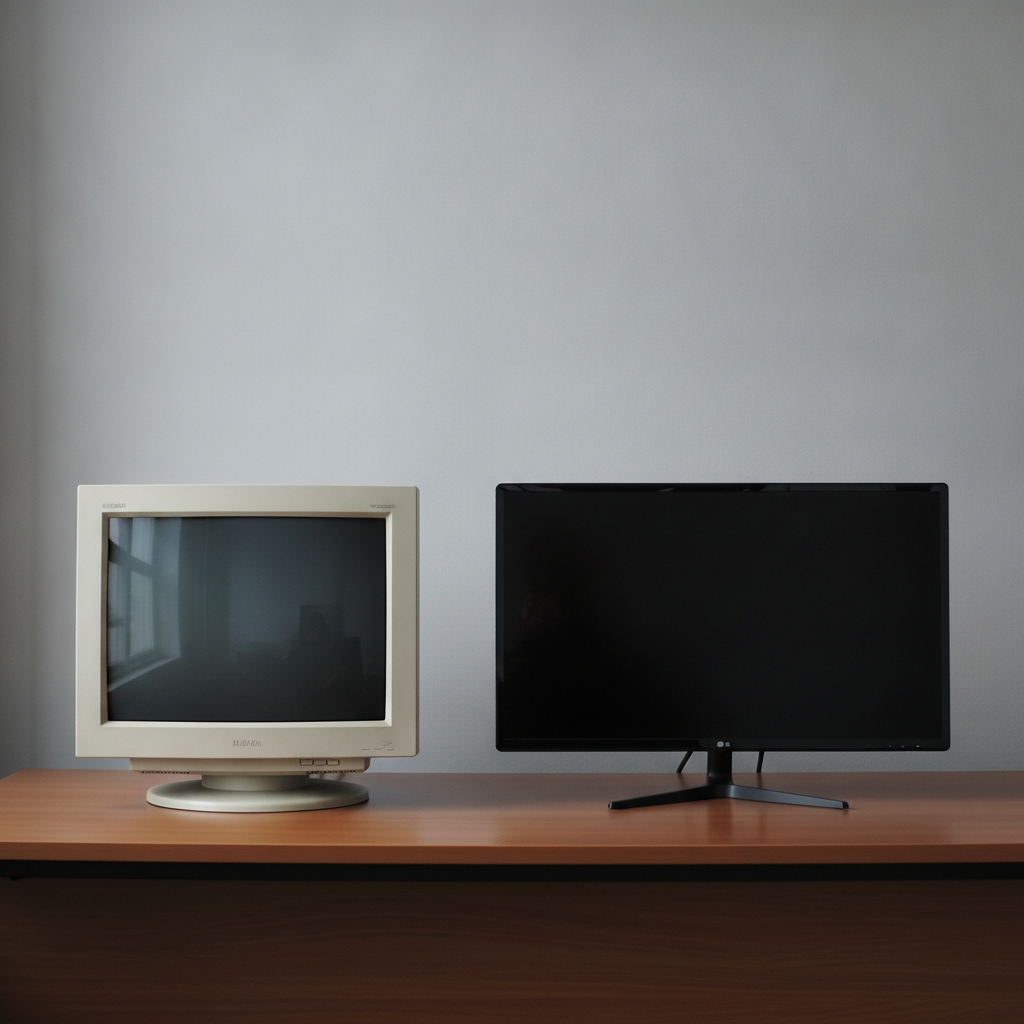
Two routes lead to running software from twenty-five years ago. Assemble hardware from the period, or emulate it on a current machine. Both work. They suit different purposes, and the choice is worth making deliberately rather than by default.
The case for real hardware
Period hardware gives behaviour that is correct by definition, because it is the thing being reproduced. Timing, audio hardware quirks, video output characteristics and input latency are all simply what they were.
Audio is where this shows most clearly. Sound cards of the era had distinctive characteristics from their synthesis chips and analogue output stages. Emulation of these has improved enormously and remains an approximation of something that varied between individual cards and even individual units.
Display output matters too. Games designed for cathode ray tubes assumed the way those displays handled scan lines and colour bleed, and some art depends on it in ways that look different on a sharp flat panel.
The costs, which are not only financial
- Components fail. Capacitors degrade, drives lose alignment, disks develop errors. Maintenance is ongoing, not one-off.
- Getting data onto the machine is a project of its own, since interfaces have moved on.
- Specific combinations of hardware still need the driver and configuration work the era demanded.
- Space and power are real constraints that get underestimated at the planning stage.
The maintenance point is the one most people underestimate. A working period machine is not a stable state but a process. Anyone whose actual goal is playing games rather than maintaining hardware should be honest about which activity they are signing up for, because it is largely the second.
The case for emulation
Emulation is available immediately, costs nothing, and has enormous practical advantages: save states, adjustable speed, straightforward file transfer, no maintenance and no failure of irreplaceable parts.
It is also, for a great deal of software, accurate enough that the differences are undetectable in play. Mature emulators for well-documented systems have had decades of work and correct behaviour that was originally wrong.
The remaining gaps are narrow and real. Analogue audio character, precise timing in edge cases, and anything depending on undocumented hardware behaviour are where approximations persist. For most purposes these do not matter. For verifying a specific claim about how something behaved, they might.
A workable way to choose
The question that resolves it is what you are actually trying to do.
- Playing games for enjoyment: emulate. The convenience advantage is enormous and the fidelity gap is small.
- Verifying a specific behaviour or timing claim: real hardware, or at minimum a second emulator to cross-check against.
- Enjoying the hardware itself as an object: real hardware, and the maintenance is part of the appeal rather than a cost.
- Archiving media: real hardware, since reading original disks and discs properly needs original drives.
That last one is worth separating out. Reading a floppy or an unusual disc format correctly is a hardware job, and it is time-sensitive in a way the others are not. Media degrades, and drives capable of reading it are becoming scarcer. Anyone holding original media that has never been imaged has a task with a deadline, whatever they decide about playing the games.
The middle path most people end up on
In practice a lot of people run emulation for everyday use and keep one modest period machine for the things emulation does not cover, particularly reading media. This gets most of the benefit of both without the maintenance burden of a full period setup.
It is also the arrangement that survives losing interest for six months, which no amount of enthusiasm makes unlikely.